We just predicted Texas and Ohio, two of the most hotly contested races in the country, with digital twins representing millions of voters. ‌ ‌ ‌ ‌ ‌ ‌ ‌ ‌ ‌ ‌ ‌ ‌
Best with motion. View the animated version
Crosswalk. The Read, November 2026.
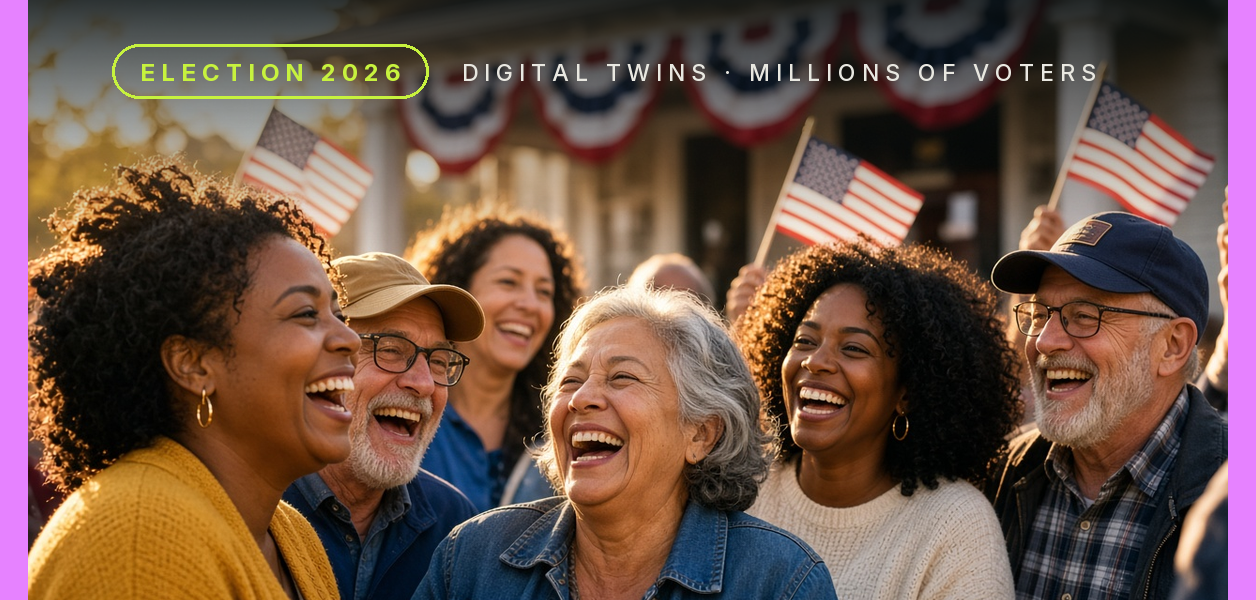
A joyful crowd of voters laughing together outside a polling place, waving small American flags. Election 2026. Digital twins, millions of voters.
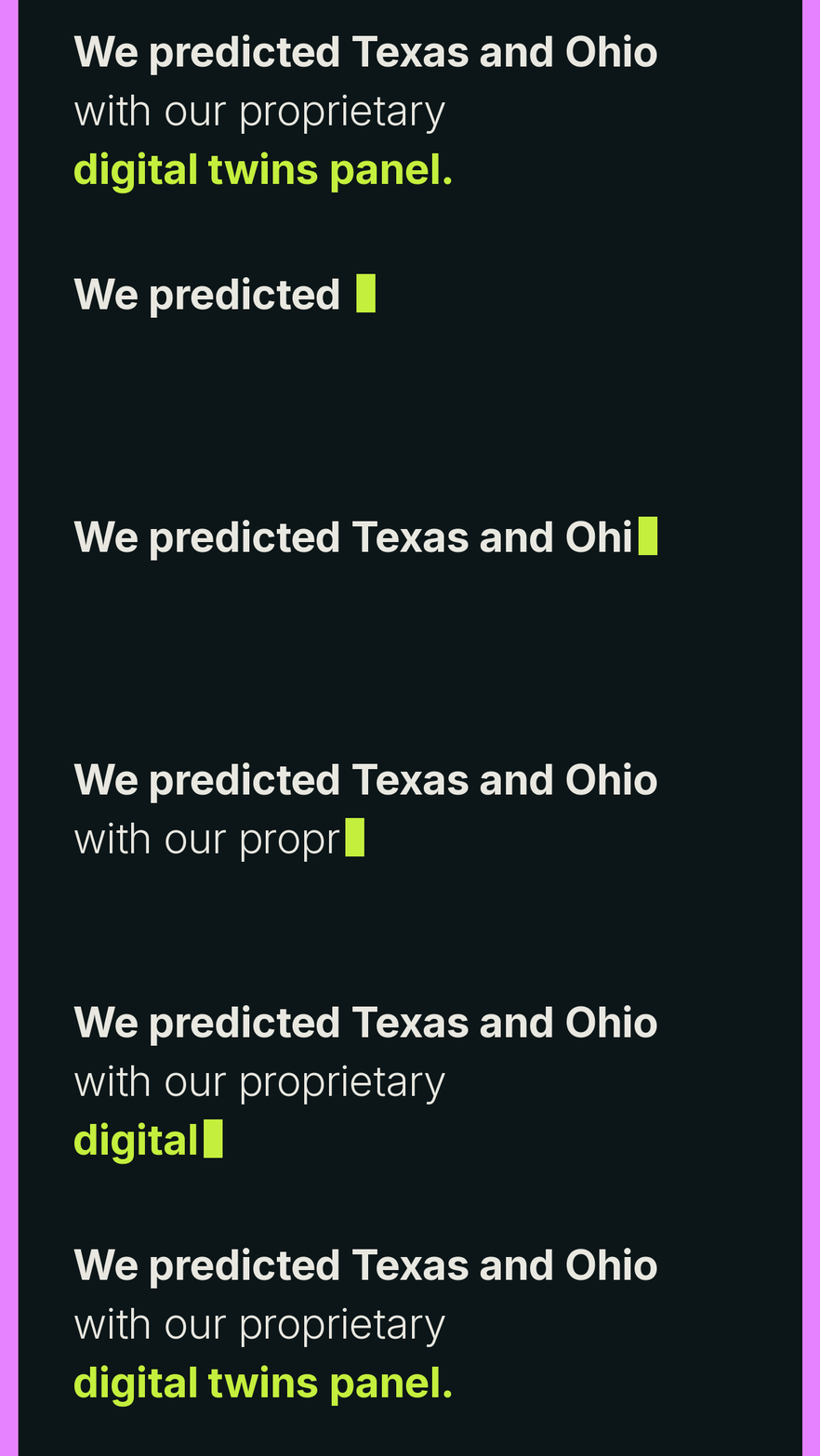
We predicted Texas and Ohio with our proprietary digital twins panel.
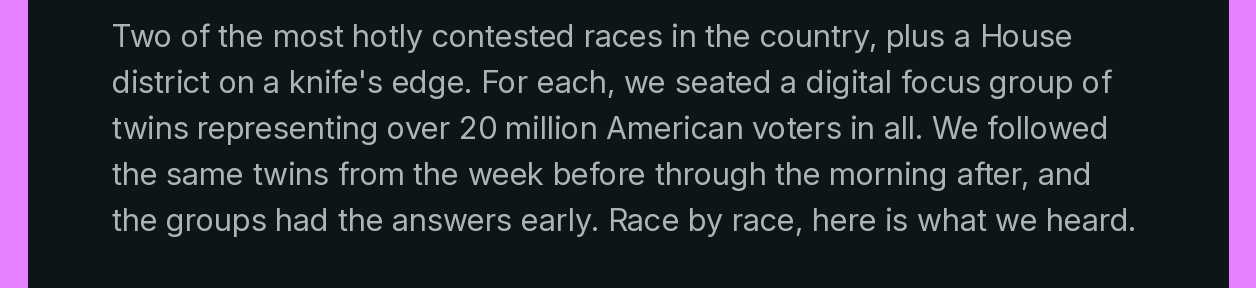
Two of the most hotly contested races in the country, plus a House district on a knife's edge. For each, we seated a digital focus group of twins representing over 20 million American voters in all. We followed the same twins from the week before through the morning after, and the groups had the answers early. Race by race, here is what we heard.
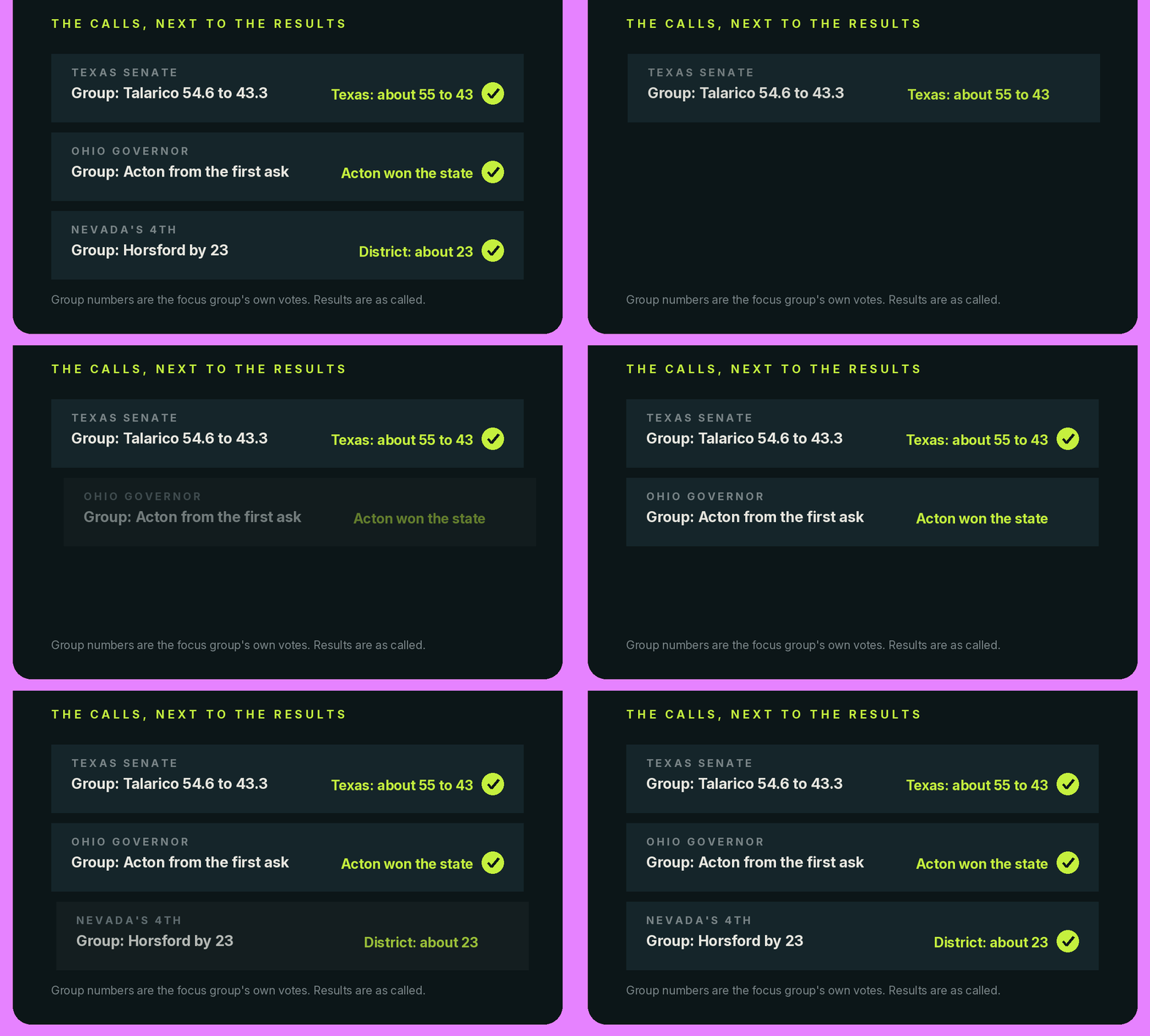
The calls, next to the results. Texas Senate: the group had Talarico 54.6 to 43.3, and Texas landed at about 55 to 43. Ohio governor: the group had Acton from the first ask, and Acton won the state. Nevada's 4th: the group had Horsford by 23, and the district landed at about 23. Group numbers are the focus group's own votes. Results are as called.
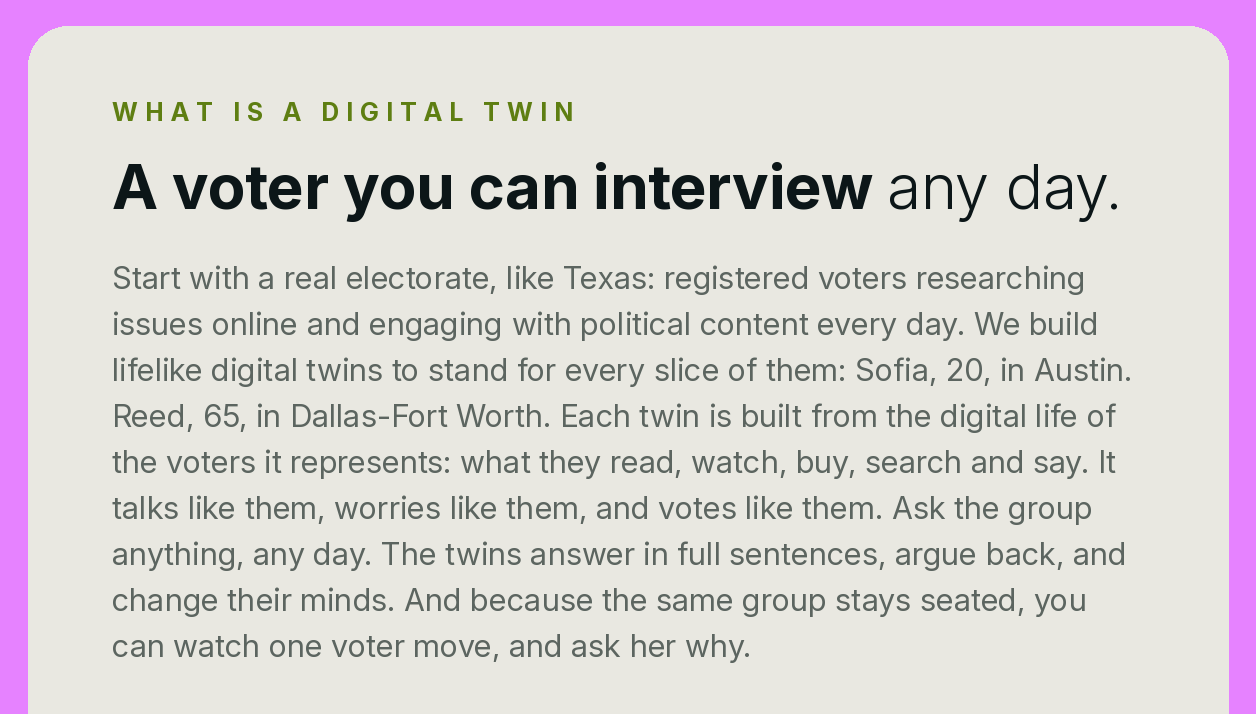
What is a digital twin? A voter you can interview any day. Start with a real electorate, like Texas: registered voters researching issues online and engaging with political content every day. We build lifelike digital twins to stand for every slice of them: Sofia, 20, in Austin. Reed, 65, in Dallas-Fort Worth. Each twin is built from the digital life of the voters it represents: what they read, watch, buy, search and say. It talks like them, worries like them, and votes like them. Ask the group anything, any day. And because the same group stays seated, you can watch one voter move, and ask her why.
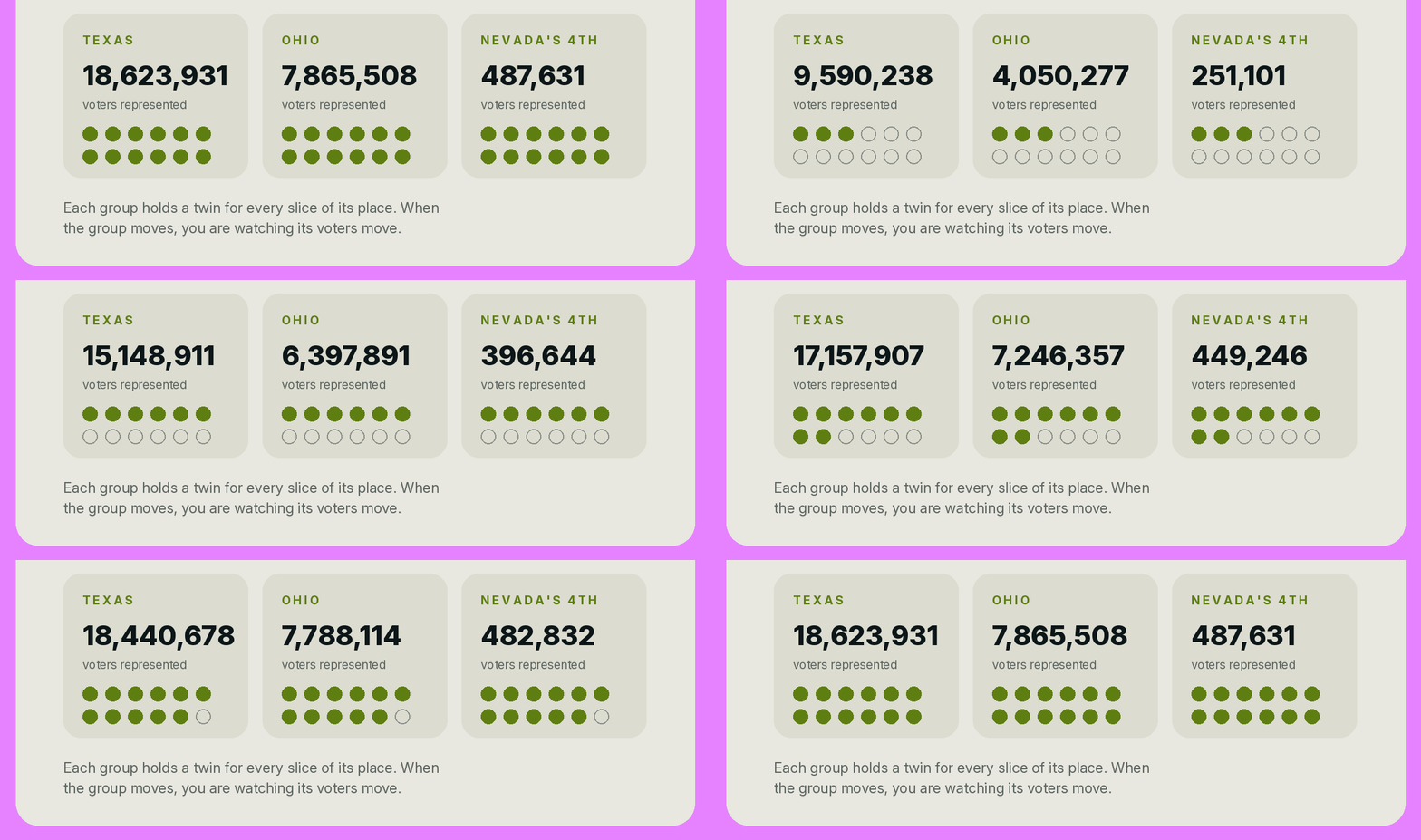
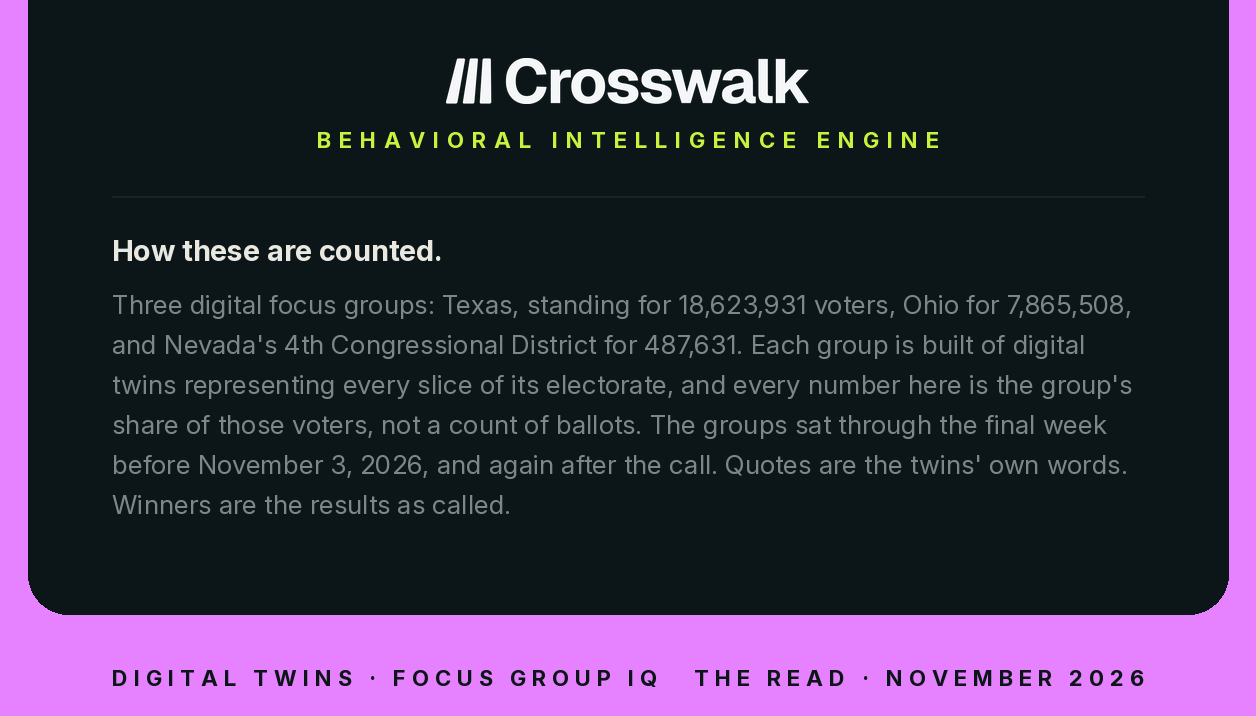
Texas: 18,623,931 voters represented. Ohio: 7,865,508. Nevada's 4th: 487,631. Each group holds a twin for every slice of its place.
A two-lane Texas highway at dusk with a windmill on the horizon. Texas, U.S. Senate: Texas hadn't sent a Democrat to the Senate since 1988.
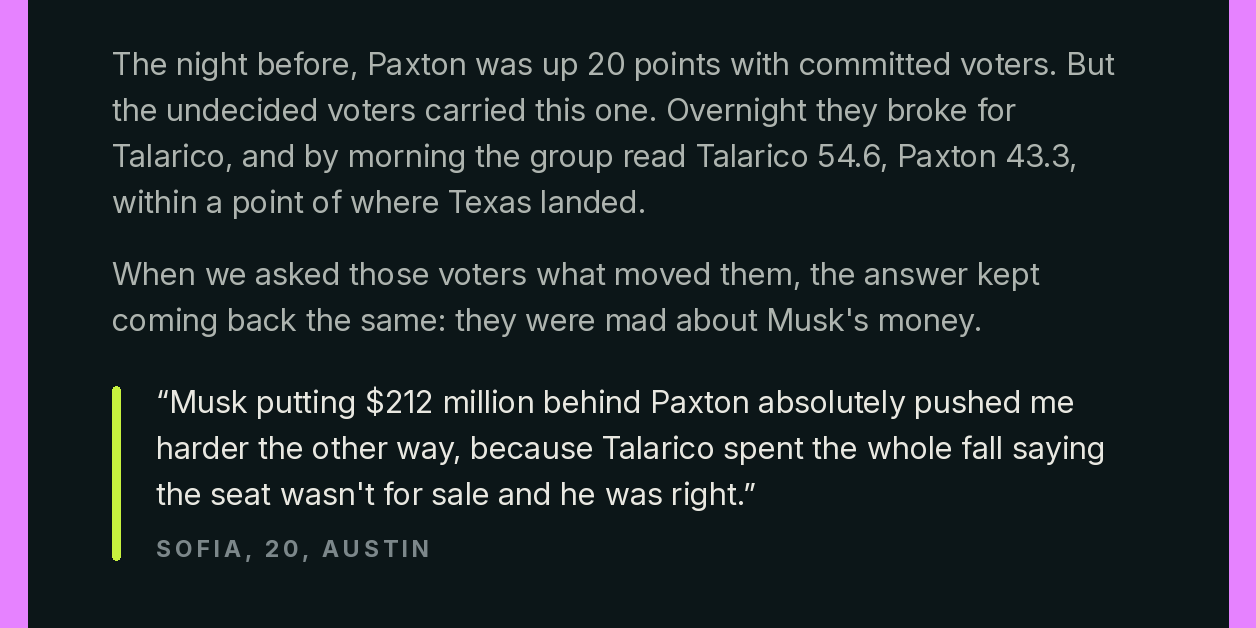
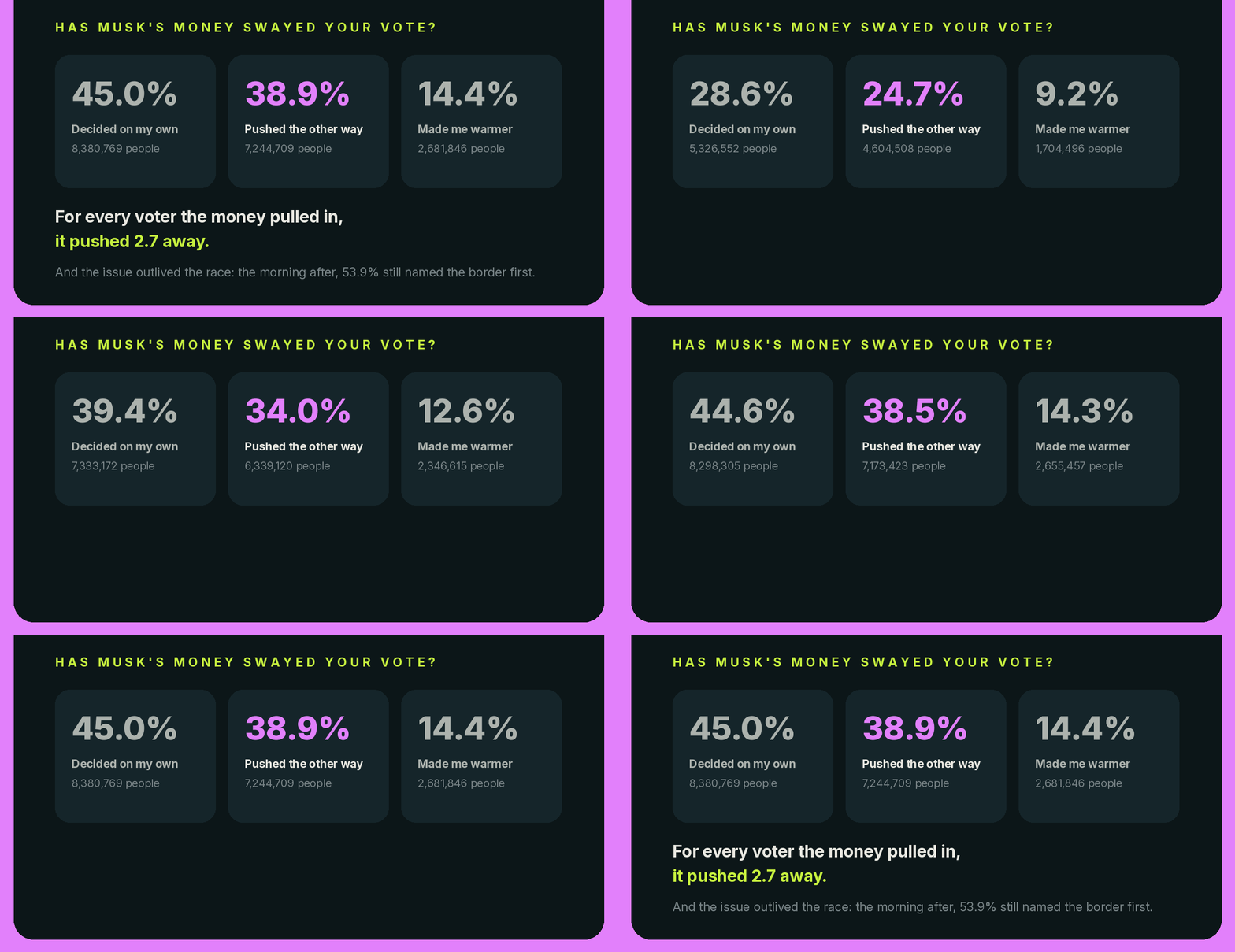
The night before, Paxton was up 20 points with committed voters. But the undecided voters carried this one. Overnight they broke for Talarico, and by morning the group read Talarico 54.6, Paxton 43.3, within a point of where Texas landed. They were mad about Musk's money. Sofia, 20, Austin: Musk putting 212 million dollars behind Paxton absolutely pushed me harder the other way, because Talarico spent the whole fall saying the seat wasn't for sale and he was right.
Has Musk's money swayed your vote? Decided on my own, 45.0 percent. Pushed the other way, 38.9 percent. Made me warmer, 14.4 percent. For every voter the money pulled in, it pushed 2.7 away.
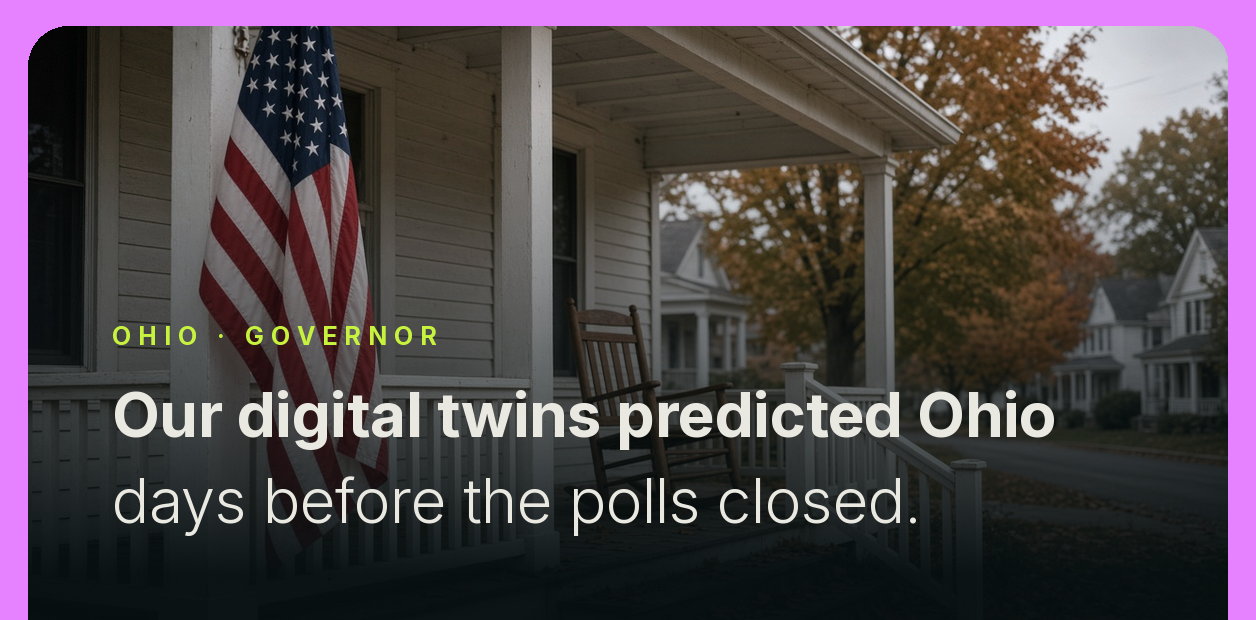
An American flag on a white porch on a tree-lined street in autumn. Ohio, governor: our digital twins predicted Ohio days before the polls closed.
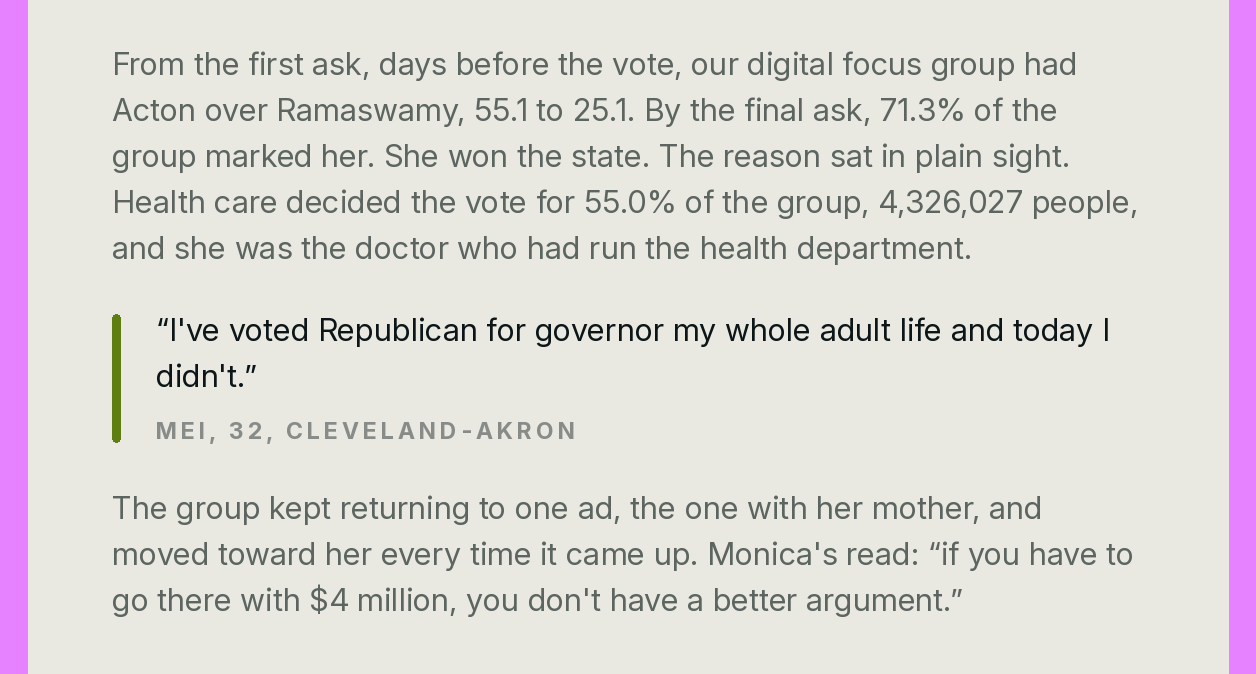
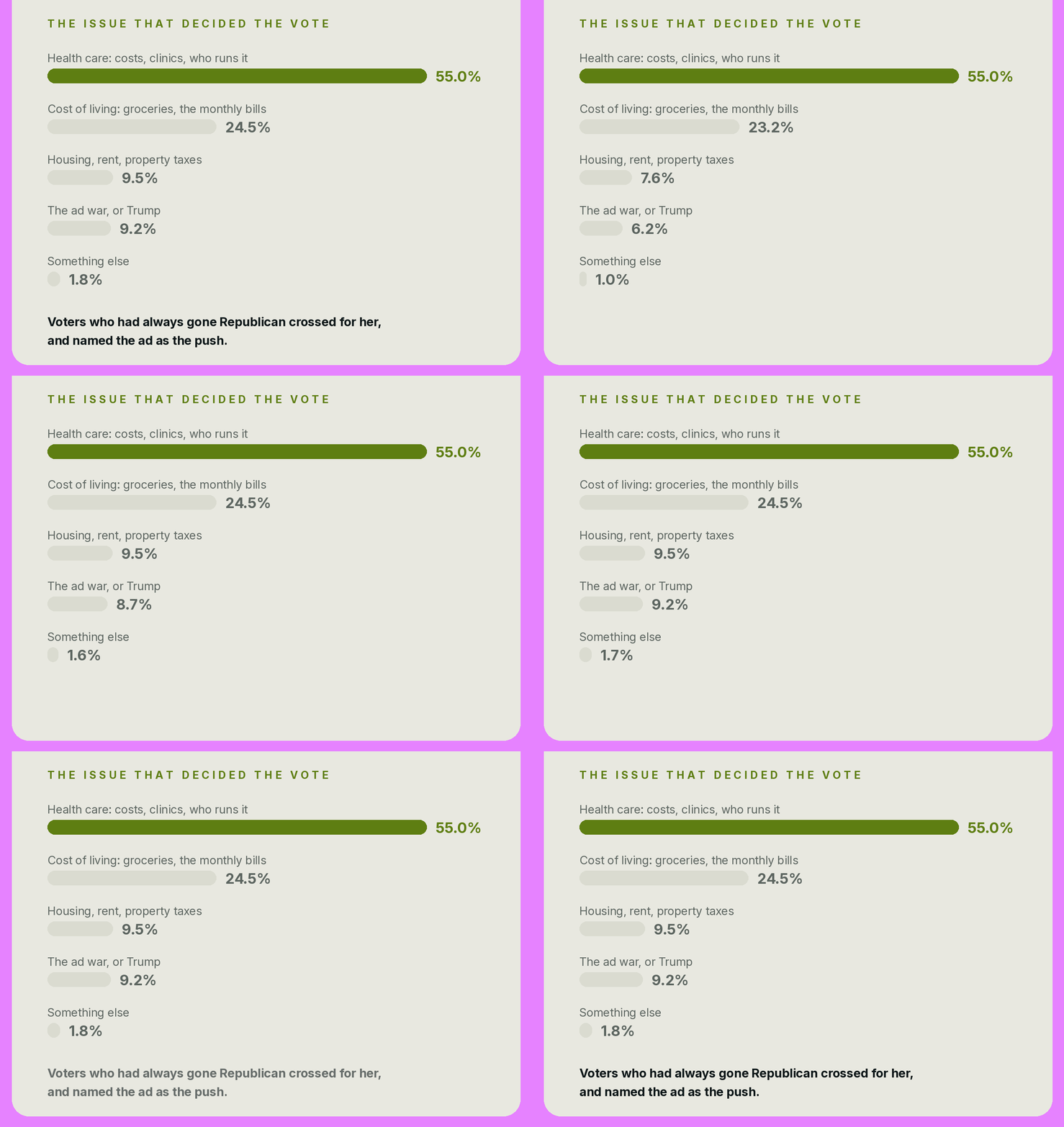
From the first ask, days before the vote, our digital focus group had Acton over Ramaswamy, 55.1 to 25.1. By the final ask, 71.3 percent of the group marked her. She won the state. Health care decided the vote for 55.0 percent of the group, and she was the doctor who had run the health department. Mei, 32, Cleveland-Akron: I've voted Republican for governor my whole adult life and today I didn't.
The issue that decided the vote: health care 55.0 percent, cost of living 24.5 percent, housing and property taxes 9.5 percent, the ad war or Trump 9.2 percent. Voters who had always gone Republican crossed for her, and named the ad as the push.
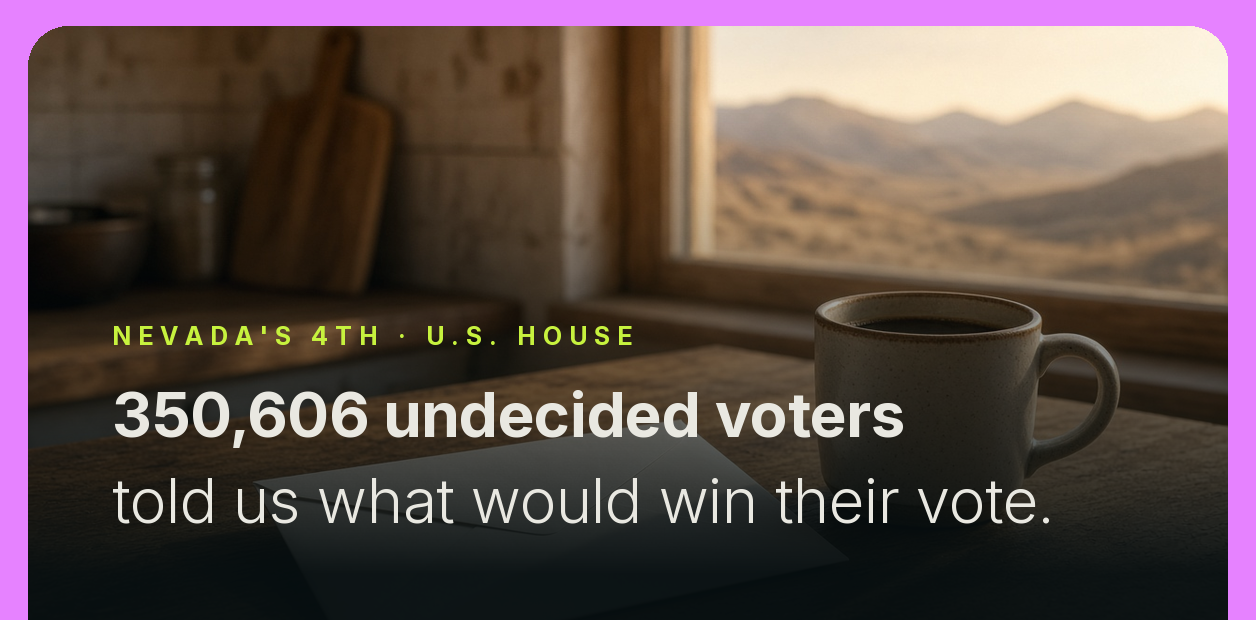
A ballot envelope and a mug of coffee on a kitchen counter, desert mountains out the window. Nevada's 4th, U.S. House: 350,606 undecided voters told us what would win their vote.
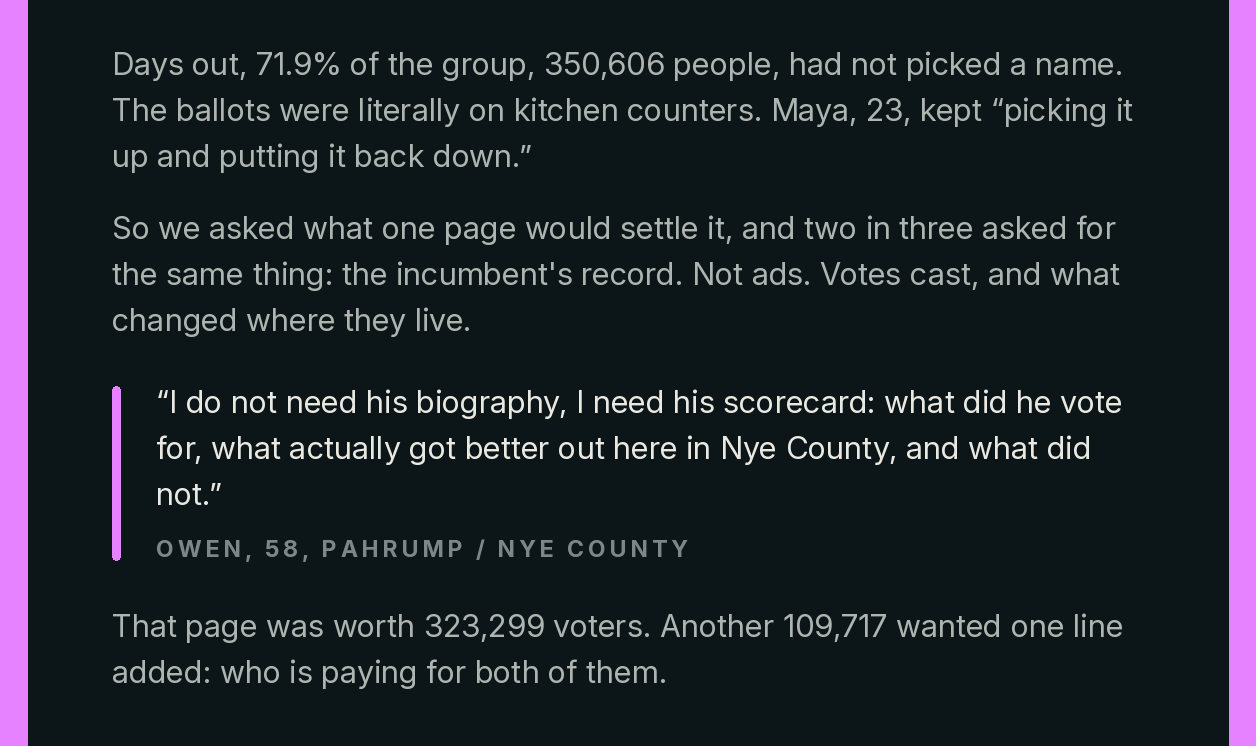
Days out, 71.9 percent of the group, 350,606 people, had not picked a name. We asked what one page would settle it, and two in three asked for the same thing: the incumbent's record. Owen, 58, Pahrump: I do not need his biography, I need his scorecard. That page was worth 323,299 voters.
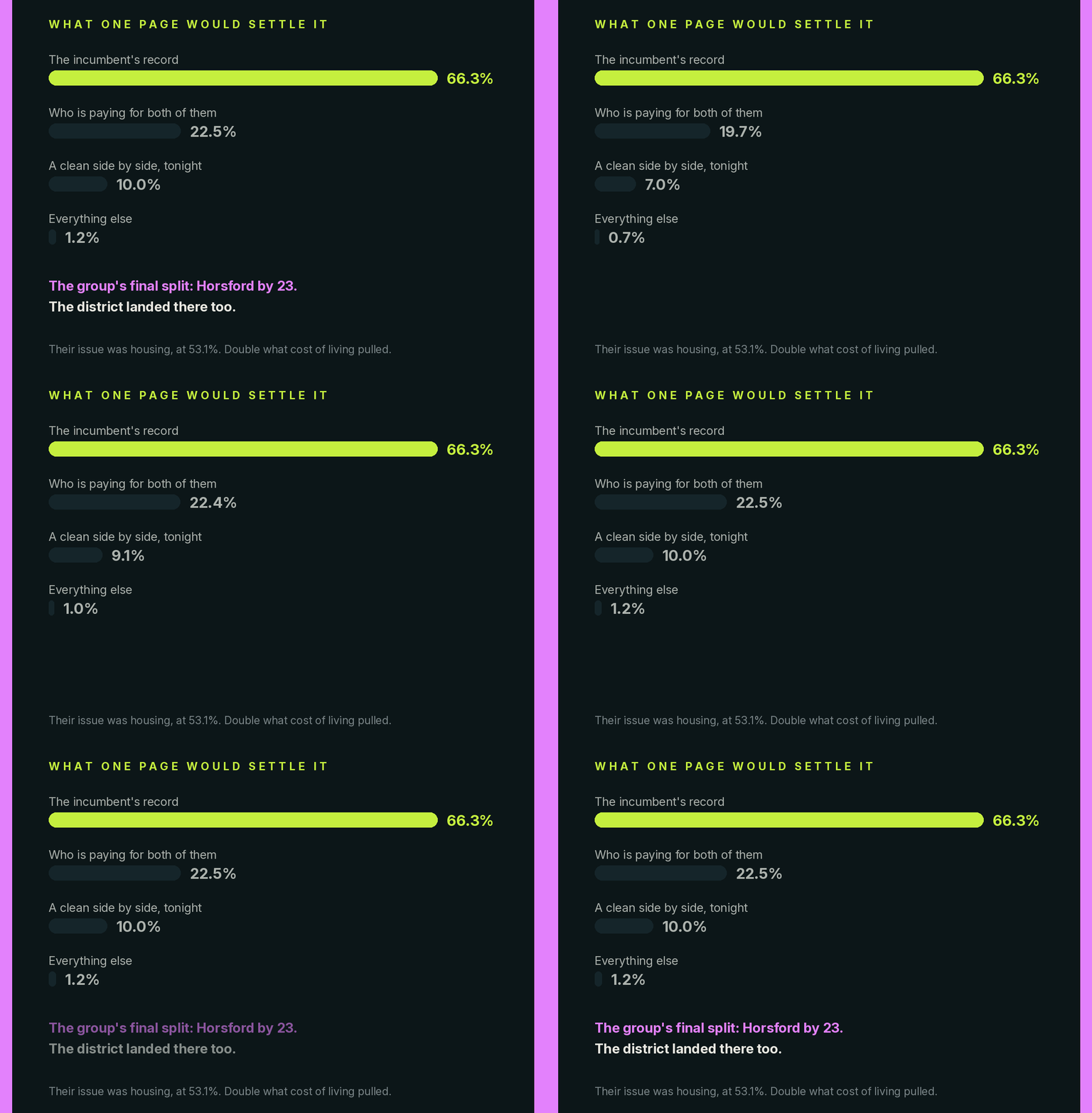
What one page would settle it: the incumbent's record 66.3 percent, who is paying for both of them 22.5 percent, a clean side by side 10.0 percent. The group's final split: Horsford by 23. The district landed there too.
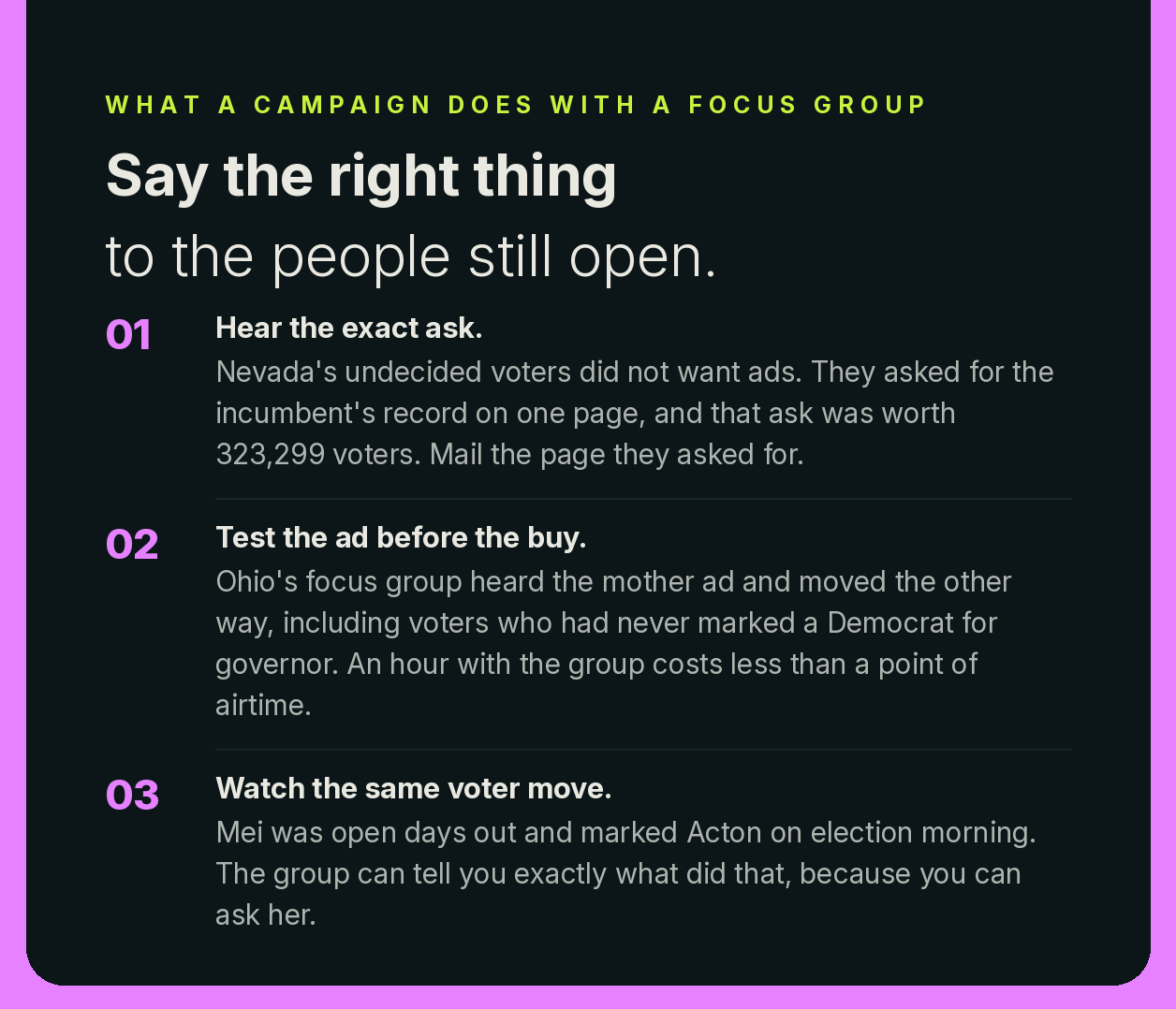
What a campaign does with a focus group: say the right thing to the people still open. One, hear the exact ask. Two, test the ad before the buy. Three, watch the same voter move.
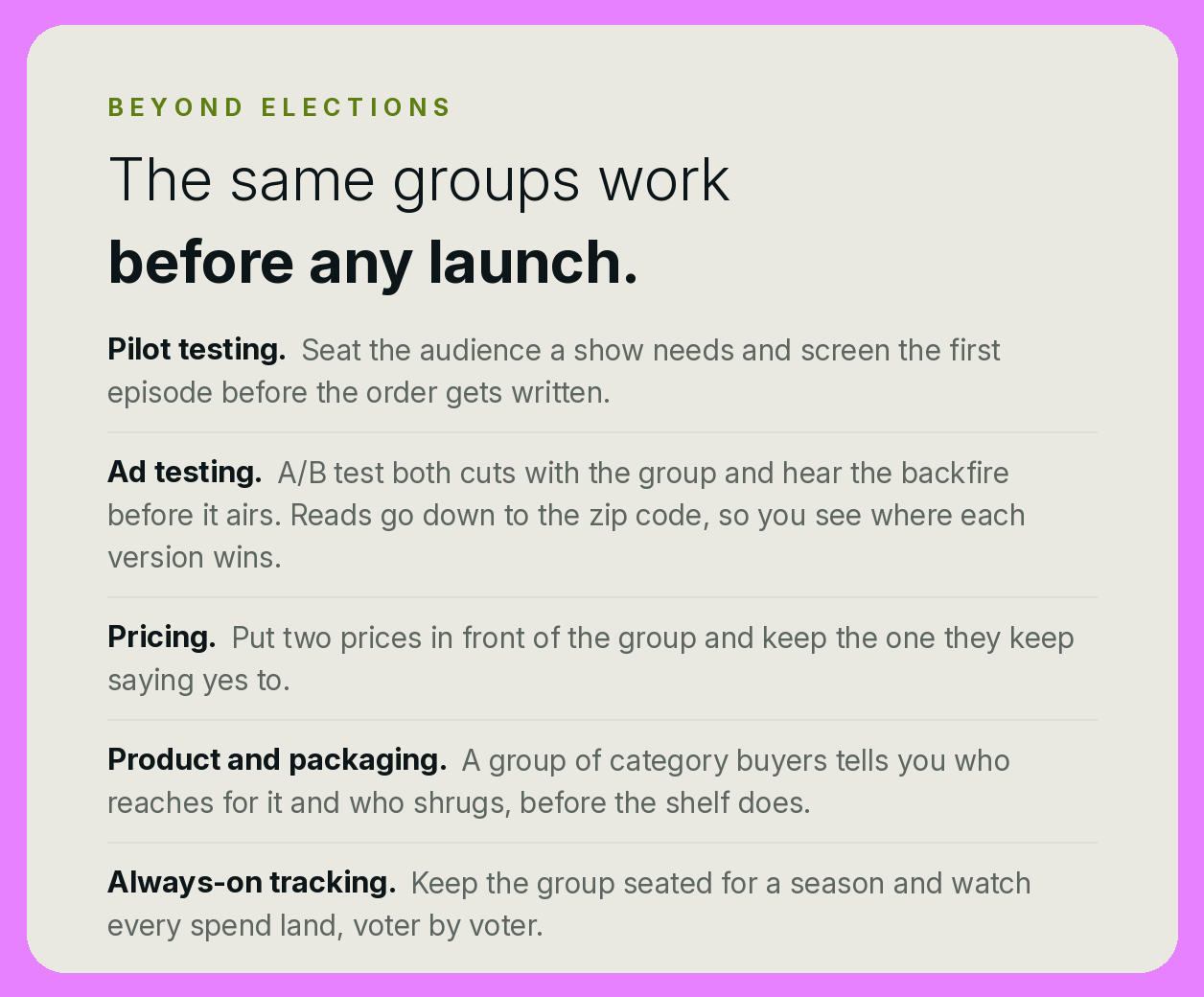
Beyond elections, the same groups work before any launch: pilot testing, A/B ad testing with reads down to the zip code, pricing, product and packaging, always-on tracking.
Want to hear the voters before the money goes out? Crosswalk can seat a digital focus group for your race, your show, or your launch this week. Learn more about Crosswalk.
Crosswalk, Behavioral Intelligence Engine. How these are counted: three digital focus groups, each built of digital twins representing every slice of its electorate. Every number here is the group's share of those voters, not a count of ballots. Quotes are the twins' own words. Winners are the results as called.
crosswalknyc.com  ·  Unsubscribe